

When I called home, my brother asked me how hard it was to learn Korean, and after a lengthy explanation, “But Chinese is easier than Korean.” I concluded. The average person, normal people who haven’t dedicated their lives to being language and martial arts study-monks, would imagine that learning Chinese is about the hardest things someone could do. But two weeks into my study of Korean, I began to suspect that Korean was harder. Six months
later, when I could read and write with ease, and possessed thousands of vocabulary words, and countless grammatical structures, but still couldn’t order off a menu, I was convinced, Korean is the hardest of the ten
languages I have studied.
Set in North East Asia, sandwiched between China and Japan, Korea has one of the most unique languages in the world. Much of the vocabulary is similar to Chinese, while the grammar is similar to Japanese. American words and
cultural influences are unmistakable. Real football (the American kind) and baseball are extremely popular collegiate sports. The players strut around the university sporting letterman jackets the same as back home.
Schools are divided into elementary, middle, and high school. A bachelor’s degree is four years; students have a major and a minor. There is a master’s degree and a doctorate. Basically the whole system mirrors the
American one. The word for pop song is pop song. The word for chicken is chicken. American movie titles are simply transliterated so “Spy Game,” is “Spy Game,” and “X-Men,” is “X-Men.”
At a glance, Korean seems that it should be the easiest language in the world for an English native speaker, who speaks Chinese. But don’t get too comfortable! Everything about Korea, from the culture to the language is
completely Korean. Sometimes the familiarity actually makes things more difficult, as you expect things to be like back home, but you find out they are different. So, when you go out to a ball game you can eat shredded, kimchi and dried squid. I never saw any of that at Yankee stadium.
“Take me out to the ball game.
Take me out with the crowd.
Buy me some kimchi and dried squid.
I don’t care if we ever get back.”
Chicken is chicken, but only when you are buying fried chicken on the street. Everywhere else, chicken is duk gogi. “Spy Game” is “Spy Game,” but spy has no meaning apart from being a movie title. In martial arts circles, the word match means a fight. But everywhere else, you say match and no one knows what you are talking about.
The weird English usage goes both ways. Most Korean dictionaries translate the Korean word PC Bang as PC Room. So when Koreans are speaking English they say they are going to the PC Room and expect you to know what that is, because it is English. It may take a while for an English native speaker to guess that PC room means internet café, a word which doesn’t exist in the Korean collective English lexicon. Another Konglish word is academy. The Koreans refer to the nighttime English schools as hack wans which, in Korean literally means study rooms or study places. But when speaking English, they refer to hack wans as academies. For most Americans, academy means a military training school. So we are shocked that children are sent to an academy at age seven or eight. The English word school is only used for a public or private primary school. If I say I am going to the Tae Kwan Do school, my Korean friends get confused. “But you are too old for school.” Thanks for reminding me about my advanced age. You forgot to point out that
I am a bit overweight too.
One of the easy features of Korean language is that the pronunciation is consonant vowel, consonant vowel. Linguistic scholars maintain that this is the easiest combination to pronounce, which is why German, which can have four or even five consonants in a series, is hard for foreigners to pronounce. As for unique sounds, Korean only has one or two sounds which we don’t have in English, such as giu he, which means church or ui sa which means doctor, the eu sound is hard for us. But once you have mastered these two phonemes, the pronunciation is not an issue.


The size of Korean words is also perfect. When you are learning Thai it is not uncommon to find words with twenty letters. Korean words usually consist of a combination of two or three syllable. (More on this later.) The best thing about learning Korean is that Hangul, the Korean writing system, is one of the easiest in the world. The Korean writing system is an alphabet, just like the western/Latin script. Hangul was created under King Sejong during the Choson Dynasty (1393-1910). King Sejong is considered to have been the greatest ruler of Korea and is credited with having brought about many positive institutions in Korea such as sunshine and the changes of season. Perhaps his contributions have been a little blown out of proportion, but he did a lot of good things for the country. As a result, the dynasty lasted until 1910. At that time, Japan invaded Korea and the country remained a Japanese colony until 1945.
Korea had been using the Chinese writing system for centuries. The Chinese claim their system is perfect. Although many scholars would disagree, the Chinese system does have one very significant advantage. The strength of the
Chinese writing system is that the pictographs (characters) have meaning, but no sound value. So, anyone, with any native tongue, can look at the Chinese characters and pronounce them in any language. As a result, Korea, Japan, Vietnam, Hong Kong, and Taiwan were all using the Chinese writing system, but pronouncing it in their own language. And all over Asia Buddhist monks were using the Chinese characters and scriptures. The disadvantage of Chinese writing, however, is that it is so bloody difficult. When I was studying in Taiwan I discovered that primary school students spent nearly half of their study time learning to read and write their native tongue. As a result, China has a surprisingly high illiteracy rate given the country’s level of development.
In the 15th century, Korea was also suffering from widespread illiteracy, due to the difficulty of the Chinese system.
In 1446 King Sejong, proclaimed a 28 letter writing system called Hangul. The word Han, meaning Korean. Today, the system has been further simplified to only 24 characters. Most foreigners find they can learn the alphabet in
about a week. Korean children are expected to have mastered the alphabet before they begin school. Being sandwiched between the huge neighbors, China and Japan, the Koreans have developed a pervasive nationalism. They are afraid that if they let their guard down at all, and begin absorbing foreign culture, their unique Korean culture will disappear. Hangul appeals to this nationalism, and is a powerful element of Korean national pride.
Although the Hangul was being taught and used in Korea, it was being used parallel to the Chinese characters. To be an educated person, and a fully functioning member of society, it was necessary to master both. Newspapers
were written in Chinese characters until the early part of the 1990s. Today, medical school, pharmacy school, and several other university departments still use textbooks written in Chinese characters.
If you don’t speak Korean, you may wonder why when you see Korean writing it looks like Chinese type characters instead of a string of letters such as in English or Russian. The reason is that Korean is written in syllables. Each syllable is a tight composition of Korean letters which fit together, like a Rubic’s cube, and look like a Chinese type character. In many instances each syllable does, in fact, correspond to a Chinese character. For example, the Korean word for library is do so guan. The Chinese word is du su gwan. The pronunciation is almost the same. And the three Korean syllables would correspond to the three Chinese characters. Where the language becomes difficult for a student of Chinese language is that in Chinese du su guan literally means study book place. So once you learn the word for library in Chinese, you have also learned the words for book and study. But in Korean, the first two syllables, do so, don’t actually have any meaning at all. The only place where the word so reoccurs for book is in the word so jum which means, book store, but again, the word is obviously borrowed from Chinese, and has nearly no other meaning.
In researching the origins of the Korean language it is difficult, although very important, to be able to separate which similarities with Chinese and Japanese are the result of a common origin, and which are loan words. I grew up speaking both Italian and Spanish. Where the languages overlapped, say 70% of the vocabulary is similar, we could attribute these similarities to a common Latin origin. So, for example kitchen, cucina in Italian and cusina in Spanish, both obviously come from the same place, showing that the languages are related. But the word toilette which is a fairly universal word, used in German and English, is a loan word, a word borrowed from French, and in no way suggests a common origin for the three languages.
(Author’s note: Before you send me any angry emails I would like to say: If we go back far enough in time, we would find that French, German, and English share a common origin. But this is not proved by the common use of
the word toilet.)
Using this type of logic, separating words demonstrating common origin from borrowed words, many scholars maintain that Korean is a completely unique language, although somewhere on the order of 30-50% of the vocabulary comes from Chinese language. One interesting observation I have made, and when I say interesting I mean only for people like me, the Korean word for weekend ju mal contains the components week and end of a time period. The Chinese word jo mo is nearly identical and uses the same Chinese characters, but it has no meaning in Chinese apart from weekend. Could this mean that weekend is a Korean word, written with Chinese characters, which was adopted by the Chinese? Since the Korean government is paying my tuition, I will say, “Yes, it
is.”
Ok, enough egg-headed details about the Korean language. Now let’s look at why learning Korean is such a traumatic experience. First off, Korean is the only language I have learned, so far, where there are two separate counting systems. They have a Chinese counting system (based on Manchurian dialect, not Mandarin) which is used for counting certain things, other things are counted with a Korean counting system. As a student of the language its frustrating trying to remember which set of numbers to use. When reading stand alone numbers, such phone numbers, addresses, ID card numbers and bus and train numbers, you use the Manchurian numbers. When
counting things, you use the Korean numbers. When telling time, however, the hours are counted with Korean numbers, but the minutes with the Chinese numbers. So 5:05 would be dasot shi o bun. Dasot being five in the Korean system and o being five in the Chinese system. Twenty-four hour shops, however, are called by the Chinese number yisip-sa shi instead of the Korean seumel net shi.
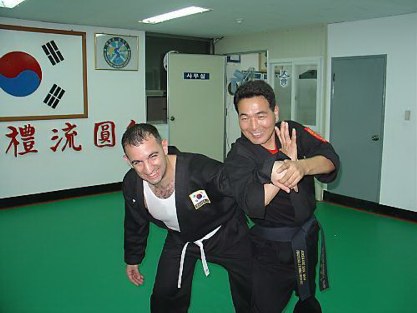
If you have ever taken Tae Kwan Do in the States, the exercises are always counted il, i, sam, sa, o, yuk…but this is incorrect because these are the Chinese numbers. When you study martial arts in Korea, the exercises are
counted using Korean numbers, han, dul, set, net, dasot, yosot… My personal waterloo in learning Korean language is the social register. In Korean language there are special ways of addressing people depending on
their status. So you use one verb form for talking to a friend, and another for talking to your parents. You would use yet another for talking to your grandparents. You also use special forms for talking about people who are more important. Just when I thought there couldn’t possibly be another verb form, I stumbled onto a sentence I couldn’t make heads or tales of. My teacher explained to me, “this is how a mother talks to her son, if she is talking about the grandfather.”
Of course!
In addition to the various address forms, Korean is the only Asian language I have studied which has a full compliment of grammar. In addition to having numerous verb tenses, Korean also has grammatical moods to convey concepts such as probability, suggestions, orders, requests, doubt…and then each of
these moods will have various forms dependent on who you are talking too. Chinese is simple in comparison. Almost everything is in the indicative and there really aren’t any tenses. Once the tense has been established, you
no longer need the various indicators. Korean also has particles which follow nouns to tell whether the word is a
name or an inanimate object, a subject, an object, plural or, a single subject which is similar to a subject already mentioned.
And so I sit, frustrated. I have memorized, at this point, literally more than one thousand main words, verbs, nouns and adjectives. And yet, every time I open my mouth I have to think, who am I talking to? What are we talking about? How sure of this am I? When did it happen? By the time I sort out all of these details, the person I wanted to talk to is home in bed. And I am left alone and speechless. The good news is, the average American male has a life expectancy of 78 years, so I still have 38 years to learn to speak Korean. Maybe by then I will have learned to like kimchi.
 Real Travel Adventures