

Historians believe that Philippine island of Palawan was once connected to Sabah, Malaysian Borneo, by a land bridge, allowing the migration of both animals and tribal people. As a result a number of rare and interesting animals can be found in Puerto Princesa, the capitol city. Puerto is home to 800 species of plants, 295 species of trees, 95 kinds of birds (15 of which are endangered). Among them is the Palawan Peacock, the city’s mascot. There are 23,779 types of insects and 41 kinds of butterflies, one of which has a wing span of 18 cm. Among the 30 types of mammals are the nocturnal Binturong (a type of carnivorous civet) and the long tailed Macaca (crab eating monkey), common in the national park, near the underground river.
The city boasts 10 kinds of amphibians, 19 kinds of reptiles, including the python and one type of cobra, and the water monitor, which can have a length of up to 2 meters and weigh 50 kgs. Illegal animal trade in reptiles is very profitable because the hide of the large animals is so valuable. As a result, many of these reptiles have become endangered species.
In recent years, the city’s mayor, Edward Hagedorn, has worked hard to stop illegal logging and poaching. Unfortunately many of the island’s unique animals have already made their way onto the endangered animal list. The city has established a crocodile conservancy, headed by Dr. Glen Rebong, to study and protect the island’s large reptiles.
The center maintains a hospital for injured crocks and a nursery, to raise endangered animals in safety. There is also a mini-zoo, open to the public. Feeding time is always pretty exciting. “The Mendorences Palawan, is one of the most endangered species in the world. There are only seventy left in the wild,” explained Dr. Glen Rebong.
The two basic crock types that the center works with are perosis, a salt water crock and Mendorences, a Philippine crock which normally only grows to two meters, although some specimens raised in captivity have grown to 10 feet long. “But Mendoredces won’t normally attack humans,” he explains. “They know that large animals are not part of their diet.”
A five meter long perosis dove at us and bit the steel walkway beneath our feet. WAM! The hardened snout crashed against the cold metal. “It probably thought it was feeding time,” explained Dr. Rebong. He assured us that we were in no danger at all. But it was still the closest I had ever been to a giant crocodile. It was similar to people who stand in a cage and feed sharks, underwater. Someone can tell you a crock is 5 meters long, but what does that mean? When you are standing near one you realize it means that this crock is nearly double my height and 5 times my weight. (OK, four times, I gained a bit recently, but I am trying to lose it.) Once again, the point was stressed that a crock will not normally attack a human. As we walked away, rather hurriedly, I thought I saw the crock vomit up a camera from the last journalist it ate.
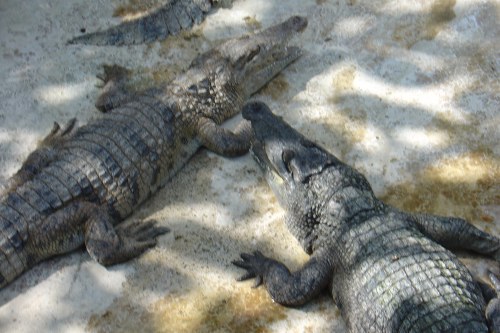
Dr. Rebong is a well respected expert in his field. He once made a discovery related to crock caves and later worked with Dr. Brady Barr, of National Geographic TV fame. “No one believed crocks could live at high altitude. But crocks were found at 750 m. Because of the cold, the crocks lived in caves.” He gave us a lot of interesting information about crocodiles. “They can go up to one year without eating, if they have big enough fat reserves. The reason they lie about with their mouths open is for cooling. Only the mouth is highly vascularized, so it is good for heat exchange.”

“We raise the eggs here until they are about two meters long. Then we transfer them outside.” By outside the doctor meant land set aside as a crocodile preserve. “It’s not exactly the wild.” Releasing crocodiles back into nature is not as simple as it may seem. “It is a very sensitive issue because if we release them to nature, we need to protect them from poachers.” Dr. Rebong explained that poachers can also read the newspapers. They will see when and where the crocks are released and go shoot them.
“We need a protected area. There must be no hunting. Also nationwide their habitat is being destroyed. The fresh water crocodile variety is now extinct in Palawna; only the salt water variety remains.” The crocks can still be found inland, however, because, according to Dr. Rebong, saltwater crocks can be found in fresh water, but fresh water crocks cannot live in salt water.
After raising these endangered animals in the sanctuary, the doctor would like to release them in the wild. But if releasing them in the wild would be too dangerous, Dr. Rebong opts for the next best option, releasing them in the semi-wild. “If there is a preserve on private land, we could give subsidies and incentives. Also, they can harvest the eggs and sell them to be used in laboratories and zoos.”
It seemed that some people gave the impression of trying to help the crocodiles, but in actuality, they were motivated by profit. “In a laboratory in Thailand they are crossing the perosis with the Siamese crocodile.”
“Hybridization has no use in science. It doesn’t preserve the species. It creates a new species and detracts from the ones you are trying to save. Why produce hybrids? Only to make a faster growing crock for skin and skin trade.”
Crocodiles are harder to save than koalas or kangaroos because people don’t find them as cuddly. “North Palawan was supposed to be a sanctuary and release area but it didn’t work out because local inhabitants didn’t want it.” The average person would probably rather the crocodiles not go extinct, but no one wants to live with them. The crocodiles also get a lot of undeserved bad press, which doesn’t help.
“There have, allegedly, been some killing,” Confesses Dr. Rebong. “A 15 foot crocodile in south Palawan is said to have killed a young girl. Now people are afraid to host crocks. In 1997 crocks ate a mailman.”
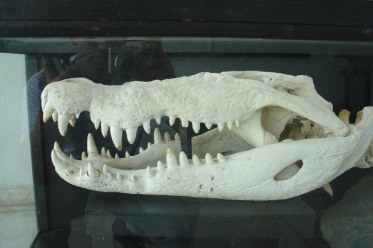
Dr. Rebong feels that the attacks have been blown out of proportion, and many of them have been unsubstantiated. “In the whole Philippines there have been very few verified attacks, only two in the last year. In some mysterious deaths or disappearances crocks have been blamed but there was no evidence.”
He didn’t believe that the crocks were to blame for the mailman’s death. “Crocks leave leftovers. They can only eat 50% of their bodyweight. Even if they ate a small child there should be something left over. Fourteen deaths have been blamed on crocodiles, but no evidence was found.”
According to Dr. Rebong, in the wild, salt water crocks are more dangerous to people than fresh water crock. “Fresh water crocks will usually back down or run away. They will recognize that we are not part of their food chain.”
Among crocodiles, however, they are very aggressive to each other. Although some salt water crocks are huge, freshwater crocks are the largest and will attack saltwater crocks. In nature, crocks will eat carrion and even resort to cannibalism. A few of the crocks in the zoo were missing a foot.
“Feeding time sometimes gets competitive. They accidentally bite the foot of the other one, and the brain is very small, so it doesn’t know and keeps eating, thinking it is chicken.” Apparently, crocodile tastes like chicken.
Supporting, feeding, and caring for the crocks is expensive. The park entrance fees are only a small fraction of what it actually costs to maintain the facility, and local donor money in a developing country is minimal. As a result, Dr. Rebong has to find creative ways to finance the crocodiles. “We let the city use some of the crocks in the adventure challenge extreme sport competition,” The runners had to run between crocks to prove their bravery. “But we were assured the crocks wouldn’t be hurt, and we were on site to supervise. Otherwise we wouldn’t have allowed it.”
“Last year, we loaned 200 crocks to the nature safari in Subic Bay. When the US Navy left, they left behind a large number of concrete bunkers, so they converted some into a crock exhibit. Sending the crocks there really took some financial pressure off us. Our annual entrance fee equals one month of entrance fees at the safari. And, if they are good, they can breed more crocodiles there.”
Educating the public is one of the most important elements in the conservation equation. “If the public is ignorant of the crocks or afraid of them then they won’t make any effort to save them. The safari park is a good opportunity for education. The Filipinos who go there are upper class because entrance fee is 300 Pesos.” The rich Filipinos are the people best in a position to save the crocks in the Philippines. People from rich countries, America, Europe and Japan, are in the best position to save the crocks in the world. The question is, will we?
 Real Travel Adventures